Architecture
Patch is three things stitched together: a local MCP server, a community registry, and a sandboxed runtime. Each has a clear job; the seams between them are the parts you should care about.
The local MCP server (@patch-cat/mcp)
Runs as a child process of your AI host (Claude Desktop, Cursor, Claude Code, Windsurf), communicating over MCP’s stdio transport. Lives in your terminal, doesn’t phone home unless you opt in.
Responsibilities:
- Exposes a small set of meta-tools (
patch_generate_tool,patch_run_tool,patch_list_tools,patch_compose,patch_confirm_action,patch_list_runs,patch_replay,patch_auth_register,patch_auth_status). - Dynamically registers each tool in your local toolbox as a first-class MCP tool. When a new tool is generated or pulled, it sends
notifications/tools/list_changedso the host refreshes its tool list within ~1 second. - Calls Claude Opus to generate Python tools, then sandbox-tests them in e2b before saving.
- Routes invocations through the security stack: sanitizer → quarantine → taint check → confirmation gate → sandbox.
- Writes a forensic audit blob for every successful execution.
State:
The toolbox persists at env-paths('patch-cat'):
patch-cat/├── tools/ one .py per tool, manifest frontmatter + body├── index.json name → {version, file path, last-used timestamp}├── runs/ one .json per execution│ └── blobs/ content-addressed stdout/stderr by SHA-256└── config.json registry URL, contribute opt-in, auth tokensThe hosted registry (@patch-cat/registry)
A Cloudflare Worker fronted by Hono, backed by Neon Postgres + R2 + Workers AI.
Responsibilities:
- Stores tool source as immutable, content-addressed R2 blobs (
tools/{sha256}.py). - Indexes tool metadata in
tools+tool_versionsPostgres tables; semantic search via pgvector HNSW on description embeddings. - GitHub OAuth for contributor identity. Bearer-token-protected
POST /v1/toolsfor contributions. - Quarantine LLM endpoint (
POST /v1/quarantine/summarize) that any client can hit to summarize untrusted text. - Self-refactoring proposals via a nightly Worker cron + a daily GitHub Actions runner.
Trust boundary: the registry serves as the coordination layer, not as a trust anchor for code execution. The local MCP server still re-validates every manifest schema, every Unicode payload, and every contributor reputation signal before pulling a tool.
The sandboxed runtime (e2b)
Every Python tool runs in an e2b sandbox. The sandbox is created with allowInternetAccess derived from the tool’s manifest:
network: false→ sandbox boots with no internet access. e2b enforces at the provider layer; the manifest declaration matches the runtime constraint by construction.network: true→ default sandbox.browser: true→ Playwright + headless Chromium are installed at sandbox boot (~15s cold-start tax). Forcesnetwork: true— you can’t browse without egress. Stays inside the e2b boundary; same trust dependency as any other tool.
The sandbox receives:
- The tool source at
/tmp/tool.py - The args JSON at
/tmp/args.json - An optional
PATCH_ACCESS_TOKENenv (Arcade-minted, scoped, short-lived) for tools withexternal_auth
The sandbox runs python /tmp/tool.py < /tmp/args.json. Output is JSON on the last line of stdout. Sandbox is destroyed after every invocation — no shared state.
What’s NOT enforced today: filesystem capability scopes (read-only, read-write, none) are advertised by the manifest but e2b’s SDK doesn’t expose a documented filesystem isolation knob. Honest gap; v0.4.x.
Trust boundaries
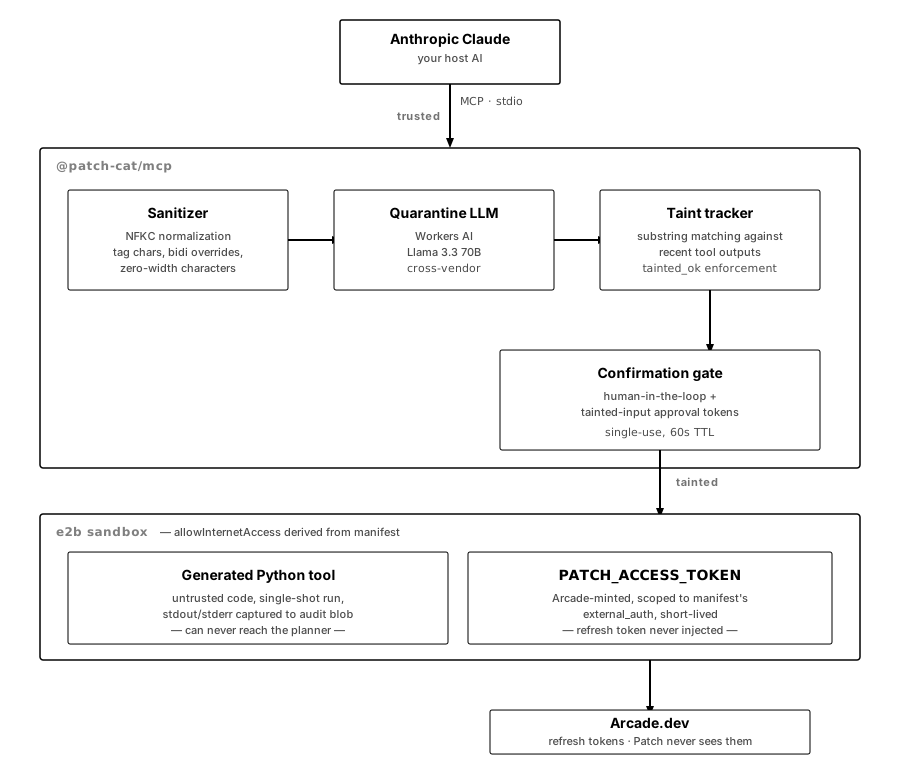
Every solid line crossing into a new box is a trust boundary that Patch validates:
- Host AI → Patch local: MCP request schema; tool name allowlist; argument types from manifest.
- Patch local → Registry: TLS + bearer-token auth on contribute; SHA-256 verification on fetched source against recorded hash.
- Patch local → e2b: capability flags pinned at sandbox-create time, not negotiable later.
- Patch local → Arcade: scope strings explicit in manifest; tokens never enter the sandbox process env keys (the value is injected; the refresh token stays at Arcade).
Replay
patch_replay({ run_id }) reads an audit blob and re-runs the recorded inputs against the recorded source in a fresh sandbox. It reports three things honestly:
| Field | Possible values | Meaning |
|---|---|---|
source_match | true / false | Local copy of the tool’s source matches the recorded SHA-256. |
sandbox_match | object | Capabilities + allowInternetAccess match what was used. |
output_match | "yes" / "no" / "na_non_deterministic" | What replay actually proves about the output. |
The na_non_deterministic case is what most replay systems gloss over. If a tool was declared network: true and replay produces a different output, that’s expected — the external world (HTTP responses, wall-clock, search results) isn’t part of the audit blob. Replay confirms the tool RAN as recorded; it cannot guarantee output equivalence for tools that depend on external state.
A "no" verdict for a network: false tool, on the other hand, is a real finding worth investigating: clock-dependent code, unseeded randomness, or a non-deterministic dependency.
This is documented in detail in the threat model.
Composition
patch_compose({ steps, on_error?, parallel? }) runs a multi-step workflow built from existing tools. Each step is { id, tool, args }; later steps reference earlier results via $step_id or $step_id.path.to.field. Sequential mode (default) lets a step consume any earlier step’s output; parallel mode runs everything concurrently with no inter-step references.
The point: composition does not bypass any defense. Every step still flows through sanitizer → quarantine → taint check → confirmation gate → sandbox. If any step returns confirmation_required (e.g. tainted input or human_confirm), the whole workflow pauses and surfaces the confirmation token — the host AI must collect explicit user approval before resuming. There is no “approve all steps” shortcut by design.
This makes the registry compounding: once fetch_url, extract_html_text, and summarize_text exist, the host AI doesn’t need to generate summarize_url. It composes them.
Stack lock
The stack choices are fixed:
- TypeScript + Node 20+ for the local server
@modelcontextprotocol/sdkfor protocol@anthropic-ai/sdk, modelclaude-opus-4-7, for tool generation@e2b/code-interpreterfor sandboxing- Cloudflare Workers + Hono + Drizzle + Neon + R2 for the registry
- Workers AI Llama 3.3 70B for the quarantine LLM
- Arcade.dev for OAuth-mediated external auth
The docs site stack (Astro + Starlight) is the only stack choice deliberately outside the lock; documented in the registry README.